 Lupita
 Measurements
How Many Grams in a Tablespoon: Chart for 40 Ingredients
The video says "two tablespoons of flour," but you have a kitchen scale. Or the recipe calls for 120 grams of sugar and you have no scale at all. This guide solves both problems: a complete gram chart for 40 common ingredients, an interactive converter, and everything you need to know about measuring tablespoons accurately.
Quick answer: 1 tablespoon of water = 15 g. But real ingredients range from 5 g (rolled oats) to 21 g (honey). Use the specific value for your ingredient — "15 grams per tablespoon" is only accurate for water and milk.
Why a tablespoon weighs differently for each ingredient
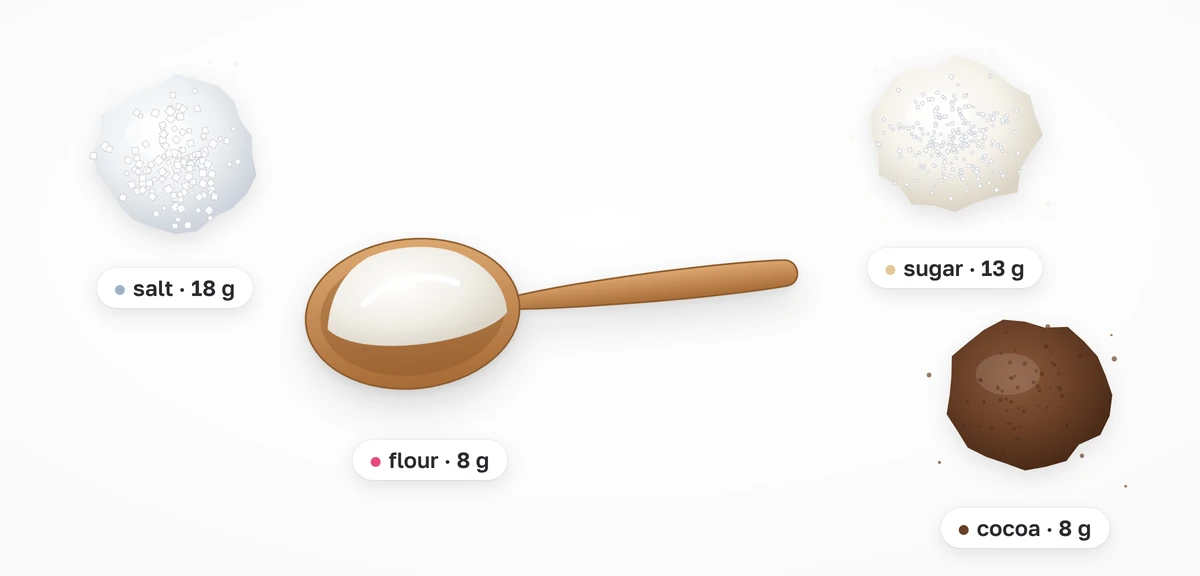
A tablespoon is a unit of volume: 15 ml. But 15 ml of salt and 15 ml of flour weigh differently because ingredients have different densities. Salt is heavy and dense, flour is light and airy. So the same spoon holds 18 grams of salt but only 8 grams of flour.
Tablespoon to grams chart (level spoon)
| Ingredient | 1 tbsp (g) | 1 tsp (g) | 1 cup 250 ml (g) |
|---|---|---|---|
| Wheat flour | 8 g | 3 g | 130 g |
| Sugar | 13 g | 4 g | 210 g |
| Powdered sugar | 8 g | 3 g | 125 g |
| Salt | 18 g | 6 g | 300 g |
| Rice | 12 g | 4 g | 200 g |
| Buckwheat | 11 g | 4 g | 180 g |
| Cocoa powder | 6 g | 2 g | 90 g |
| Milk | 15 g | 5 g | 258 g |
| Water | 15 g | 5 g | 250 g |
| Sour cream | 15 g | 5 g | 250 g |
| Vegetable oil | 14 g | 5 g | 230 g |
| Honey | 21 g | 7 g | 355 g |
| Butter | 14 g | 5 g | 240 g |
| Rolled oats | 6 g | 2 g | 90 g |
| Baking soda | 12 g | 4 g | 200 g |
| Baking powder | 11 g | 4 g | 185 g |
| Ground cinnamon | 7 g | 2.5 g | 115 g |
| Ground coffee | 5 g | 2 g | 85 g |
| Olive oil | 14 g | 5 g | 225 g |
| Cornstarch | 8 g | 3 g | 130 g |
| Semolina | 12 g | 4 g | 200 g |
| Soy sauce | 17 g | 6 g | 280 g |
| Ketchup | 15 g | 5 g | 250 g |
| Mayonnaise | 15 g | 5 g | 255 g |
| Cream cheese | 15 g | 5 g | 250 g |
| Ground pepper | 6 g | 2 g | 95 g |
| Paprika | 7 g | 2.5 g | 120 g |
| Turmeric | 8 g | 3 g | 130 g |
| Dried yeast | 9 g | 3 g | 150 g |
| Gelatin (powder) | 8 g | 3 g | 130 g |
Level spoons. 184 ingredients with real densities are in the Lupita app, in the Converter tab.
How to measure a tablespoon accurately
Most kitchens have two completely different things called a "tablespoon" — a standard measuring spoon (exactly 15 ml) and a cutlery tablespoon from a cutlery set (anywhere from 12 to 20 ml). For cooking, either usually works. For baking, use a measuring spoon.
- Dip and overfill. Push the spoon into the ingredient — don't scoop from the surface, which tends to under-fill.
- Level with a straight edge. Lay a knife or spatula flat across the top and sweep off the excess. This is what "level tablespoon" means.
- Don't pack dry ingredients (unless the recipe says "packed"). Packed flour can hold 30–40% more than level flour.
- For sticky liquids (honey, syrup, molasses), lightly grease the spoon with oil first. The liquid will slide off cleanly instead of sticking.
- For critical baking amounts (baking powder, baking soda), weigh on a scale. A 1 gram error in either can affect the texture of the final product.
Converter: tablespoons to grams
Level or heaped?
Unless the recipe says otherwise, use a level spoon — sweep off the excess with a knife. A heaped spoon holds roughly 50% more: about 12 grams of flour instead of 8, or 27 grams of salt instead of 18. In savory cooking this rarely matters. In baking, a heaped tablespoon of baking powder (17 g instead of 11 g) will cause your cake to rise violently and then collapse, leaving a dense, gummy center with a metallic aftertaste.
Quick tablespoon reference — common recipe amounts
Most recipes use tablespoons in increments. Here are the most common amounts for flour and sugar, pre-calculated:
| Amount | Flour (g) | Sugar (g) | Butter (g) | Honey (g) |
|---|---|---|---|---|
| ½ tbsp | 4 g | 6.5 g | 7 g | 10.5 g |
| 1 tbsp | 8 g | 13 g | 14 g | 21 g |
| 2 tbsp | 16 g | 26 g | 28 g | 42 g |
| 3 tbsp | 24 g | 39 g | 42 g | 63 g |
| 4 tbsp (¼ cup) | 32 g | 52 g | 56 g | 84 g |
| 8 tbsp (½ cup) | 64 g | 104 g | 112 g | 168 g |
| 16 tbsp (1 cup) | 130 g | 210 g | 240 g | 355 g |
Tablespoon sizes around the world
The tablespoon isn't the same size everywhere, which causes real confusion when following international recipes:
- US tablespoon: 14.8 ml (officially 15 ml) — the standard in American recipes
- UK tablespoon: 15 ml — same as US for practical purposes
- Metric tablespoon: 15 ml — used in most of continental Europe
- Australian tablespoon: 20 ml (4 teaspoons, not 3) — significantly larger
The Australian tablespoon is the biggest catch. If you're following an Australian recipe and use a US tablespoon, you're using 75% of what the recipe calls for. A recipe that says "2 Australian tablespoons of flour" means 40 ml = 2.67 US tablespoons. When using recipes from Australian food sites like Taste.com.au or Donna Hay, multiply tablespoon quantities by 1.33.
Tablespoon vs teaspoon — when each is used
Recipes use tablespoons for larger quantities and teaspoons for smaller ones. The dividing line is roughly:
- Tablespoons: oil, butter, sugar, flour, sauces, condiments, honey — anything where you need 10–50 grams
- Teaspoons: salt, spices, baking powder, baking soda, vanilla — smaller amounts where accuracy matters more
A useful mental model: if you'd add it with a soup spoon while cooking, the recipe will usually call for tablespoons. If you'd pinch it from a spice jar, it's probably teaspoons. See our teaspoon to grams guide for the smaller measurements.
Converting tablespoons to grams without a calculator
If you need a quick mental approximation without looking up specific values:
- Water, milk, cream, juice: 15 g per tablespoon
- Most oils: 14 g per tablespoon
- Most sugars: 12–13 g per tablespoon
- Most flours: 8 g per tablespoon
- Most ground spices: 6–7 g per tablespoon
- Honey and thick syrups: 21 g per tablespoon
These rough rules won't replace a scale for precision baking, but they're close enough for most savory cooking and give you a quick sanity check when a recipe seems off.
Get the whole recipe in grams — in one tap
Paste a TikTok, Instagram or YouTube link. Lupita pulls out the ingredients with exact weights and steps. 184 ingredients, offline.
Frequently asked questions
How many grams of flour in a tablespoon?
About 8 grams level and 12 grams heaped. Wheat flour is light and airy, so a tablespoon holds much less than denser ingredients like salt or sugar.
What is the difference between a tablespoon and a teaspoon?
A tablespoon is 15 ml, a teaspoon is 5 ml — three times smaller. 3 teaspoons = 1 tablespoon.
How many tablespoons in a cup?
A standard US cup (240 ml) holds 16 tablespoons. A metric cup (250 ml) holds about 16.7 tablespoons.
How many grams of sugar in a tablespoon?
Granulated sugar: about 13 grams per level tablespoon. Powdered sugar: about 8 grams because it is less dense.
How many grams of butter in a tablespoon?
About 14 grams per level tablespoon. Softened and melted butter have slightly different weights but the difference is minimal for most recipes. In US recipes, butter sticks are often measured by tablespoon — one standard US stick (½ cup) = 8 tablespoons = 113 grams.
How many grams of honey in a tablespoon?
Honey is one of the densest common kitchen ingredients: one level tablespoon weighs approximately 21 grams. Maple syrup is similar at 20 grams per tablespoon. Both are significantly heavier than water (15 g/tbsp) because of their high sugar content and thick consistency.
Is an Australian tablespoon different from US?
Yes — an Australian tablespoon is 20 ml (4 teaspoons), while a US tablespoon is 15 ml (3 teaspoons). If you follow an Australian recipe with a US tablespoon, you'll use 75% of the intended amount. Multiply Australian tablespoon amounts by 1.33 when using US measuring spoons.
How many tablespoons in a cup?
A standard US cup (240 ml) holds 16 tablespoons. A metric cup (250 ml) holds about 16.7 tablespoons. ¼ cup = 4 tablespoons, ⅓ cup ≈ 5 tablespoons + 1 teaspoon, ½ cup = 8 tablespoons.