 Lupita
 Measurements
How Many Grams in a Cup of Flour?
All-purpose flour: cups to grams
All-purpose flour is the most common flour in recipes. This table covers every cup fraction you are likely to see in a recipe, from a teaspoon to 4 cups.
| Amount | Grams — spooned & leveled | Grams — scooped |
|---|---|---|
| 1 teaspoon | 2.5 g | 3 g |
| 1 tablespoon | 7.5 g | 9 g |
| ⅛ cup | 15 g | 16 g |
| ¼ cup | 30 g | 32 g |
| ⅓ cup | 40 g | 43 g |
| ½ cup | 60 g | 65 g |
| ⅔ cup | 80 g | 87 g |
| ¾ cup | 90 g | 98 g |
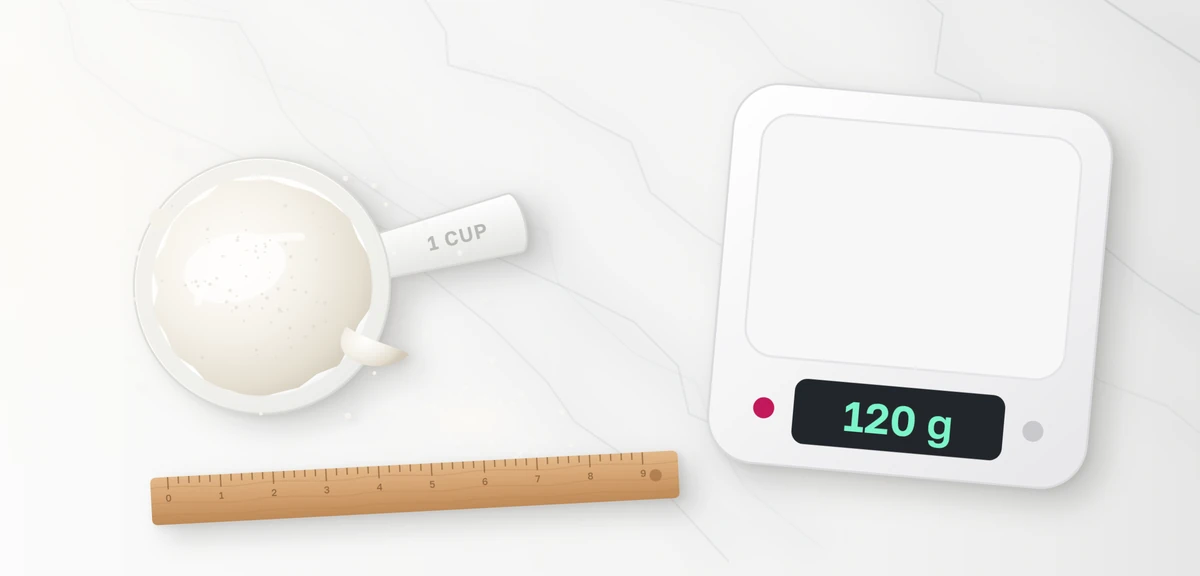
| 1 cup | 120 g | 130 g |
| 1¼ cups | 150 g | 163 g |
| 1½ cups | 180 g | 195 g |
| 1⅔ cups | 200 g | 217 g |
| 2 cups | 240 g | 260 g |
| 2½ cups | 300 g | 325 g |
| 3 cups | 360 g | 390 g |
| 4 cups | 480 g | 520 g |
All flour types: 1 cup in grams
Different flours have very different densities. Cake flour is milled to a finer particle size than bread flour, so it packs less tightly. Almond flour, made from ground nuts, is lighter still. Always use the weight for the specific flour type your recipe calls for.
| Flour type | 1 cup in grams | Notes |
|---|---|---|
| All-purpose flour | 120 g | Spooned & leveled; most common US baking standard |
| Bread flour | 120 g | Same weight as AP flour; slightly higher protein content |
| Cake flour | 100 g | Finer grind, lower density; lightens cakes and biscuits |
| Pastry flour | 114 g | Between AP and cake flour in protein and density |
| Whole wheat flour | 120 g | Same cup weight as AP; denser texture in the final bake |
| White whole wheat flour | 120 g | Milder flavour than regular whole wheat |
| Spelt flour | 120 g | Ancient grain; slightly nuttier flavour than wheat |
| Rye flour | 102 g | Lighter than wheat flour; common in sourdough and dark breads |
| Buckwheat flour | 120 g | Gluten-free; earthy flavour; used in pancakes and blinis |
| Oat flour | 90 g | Gluten-free; light and slightly sweet |
| Rice flour | 160 g | Denser than wheat flour; gluten-free |
| Almond flour | 96 g | Ground blanched almonds; common in keto and gluten-free baking |
| Coconut flour | 112 g | Very absorbent; use much less than wheat flour in recipes |
| Cornstarch (cornflour) | 120 g | Thickener, not a baking flour; same weight as AP flour per cup |
| Semolina flour | 167 g | Coarsely ground durum wheat; heaviest flour in this table |
Cup fractions to grams — quick reference
This table shows the four most common flour types side by side across the most common cup fractions.
| Amount | All-purpose | Cake flour | Whole wheat | Almond flour |
|---|---|---|---|---|
| ¼ cup | 30 g | 25 g | 30 g | 24 g |
| ⅓ cup | 40 g | 33 g | 40 g | 32 g |
| ½ cup | 60 g | 50 g | 60 g | 48 g |
| ¾ cup | 90 g | 75 g | 90 g | 72 g |
| 1 cup | 120 g | 100 g | 120 g | 96 g |
| 2 cups | 240 g | 200 g | 240 g | 192 g |
| 3 cups | 360 g | 300 g | 360 g | 288 g |
Why flour weight varies by measuring method
A cup of flour can weigh anywhere from 110 g to 160 g depending on how you fill the cup. This is not a flaw in the measurement system — it is just physics. Flour is a powder, and powders compress.
There are three main ways people fill a measuring cup, and they give different results:
- Spoon and level (120 g). Spoon flour into the cup with a separate spoon until it mounds over the top, then sweep a straight edge across the rim. This is the method most US recipe developers use and the one that produces 120 g per cup for all-purpose flour.
- Scoop and level (125–130 g). Dip the cup directly into the flour bag and scoop up a cupful, then level the top. The scooping action compresses the flour and packs in 5–10 g more than the spoon method.
- Sifted (110 g). Sift the flour first, then spoon into the cup. Sifting aerates the flour and reduces the weight per cup. Some older recipes specify "1 cup sifted flour" — this is different from "1 cup flour, sifted."
In baking, a 10 g difference in flour per cup compounds across a recipe. A recipe that calls for 3 cups of flour could have 30 g more or less depending on your technique. That is enough to make cookies spread flat, bread fail to rise, or a cake come out dense. Weighing in grams eliminates the variable entirely.
How to measure flour accurately
The fastest and most reliable method is a kitchen scale. Zero out the scale with your bowl on it, add flour until you hit the target weight, and proceed. No cups needed, nothing to clean, zero ambiguity.
If you do not have a scale and must use cups:
- Stir the flour in its bag or container first to loosen it — flour settles during storage.
- Spoon flour into the measuring cup with a separate spoon until it mounds over the rim.
- Level off the top with a straight edge (the back of a knife works).
- Never tap or shake the cup — that settles the flour and adds weight.
Frequently asked questions
- How many grams is 1 cup of all-purpose flour?
- 120 grams, using the spoon-and-level method. If you scoop the cup directly into the bag, you get 125–130 grams. Most professional baking recipes use 120 g as the standard for all-purpose flour.
- Is 1 cup of flour 200g?
- No. 1 cup of all-purpose flour is 120 g. The 200 g figure is often confused with 1 cup of granulated sugar, which does weigh 200 g. If a recipe specifies 200 g of flour, that is approximately 1⅔ cups.
- How many grams is 2 cups of flour?
- 2 cups of all-purpose flour = 240 grams (spooned and leveled). For other types: 2 cups of cake flour = 200 g, 2 cups of almond flour = 192 g, 2 cups of rice flour = 320 g.
- How many grams is half a cup of flour?
- ½ cup of all-purpose flour = 60 grams. ½ cup of cake flour = 50 g. ½ cup of almond flour = 48 g. ½ cup of whole wheat flour = 60 g.
- How many grams is ¼ cup of flour?
- ¼ cup of all-purpose flour = 30 grams. ¼ cup of cake flour = 25 g. ¼ cup of almond flour = 24 g.
- Why does a cup of flour weigh different amounts?
- Flour compresses when scooped. Spooning flour into a cup and leveling gives 120 g. Scooping the cup directly into the bag packs in more and gives 125–130 g. The measuring method, the flour type, and whether it was sifted all affect the weight. Weighing on a scale eliminates all three variables.
- How many cups is 100 grams of flour?
- 100 grams of all-purpose flour is approximately ⅔ cup (0.83 cups). More precisely: 100 ÷ 120 = 0.83 cups. For cake flour, 100 g = exactly 1 cup.
- How many cups is 250 grams of flour?
- 250 grams of all-purpose flour is approximately 2 cups + 1 tablespoon (2.08 cups). For cake flour, 250 g = 2.5 cups.
- Does sifting flour change its gram weight?
- Yes. Sifting aerates the flour and reduces the weight per cup to approximately 110 g. If a recipe says "1 cup sifted flour," sift before measuring. If it says "1 cup flour, sifted," measure first then sift.
Sources
- King Arthur Baking — Ingredient Weight Chart — industry reference for US flour gram weights
- Serious Eats — How to Measure Flour — spoon-and-level vs scoop method comparison
- USA Rice Federation — rice flour density values