Measurements
Every scaling problem comes down to one calculation:
Say you found a pasta sauce recipe that serves 4, but you're cooking for 10. The scale factor is 10 ÷ 4 = 2.5. Take every ingredient — 400 g tomatoes, 2 cloves garlic, 1 tsp salt — and multiply by 2.5. You get 1,000 g tomatoes, 5 cloves garlic, 2.5 tsp salt. That's the whole method.
Going the other way works identically. Recipe serves 8, you need 2: 2 ÷ 8 = 0.25. Everything shrinks to a quarter.
These are the factors you'll reach for most often:
| Goal | Factor | Example: 2 cups flour → |
|---|---|---|
| Third the recipe | ×0.33 | ⅔ cup |
| Halve the recipe | ×0.5 | 1 cup |
| Original | ×1 | 2 cups |
| 1.5× (one and a half) | ×1.5 | 3 cups |
| Double | ×2 | 4 cups |
| Triple | ×3 | 6 cups |
| Quadruple | ×4 | 8 cups |
Most ingredients scale in a straight line. A handful don't, and getting them wrong ruins the dish.
A scale factor of 1.5 gives you 1.5 eggs. That's not a problem — beat the egg and weigh it. According to USDA FoodData Central, a large egg weighs about 50 g out of the shell: roughly 30 g white and 18 g yolk. Half an egg is 25 g. Measure it on a kitchen scale and use that. For most baked goods this works perfectly; for something very egg-sensitive like a soufflé, round to the nearest whole egg and adjust the other liquids slightly.
Scale these proportionally up to about 2×. When you get to 3× and beyond, start pulling back. Too much leavening causes the structure to overexpand and then collapse, leaving a dense, gummy result. A practical rule: at 3×, use 2.5× the leavening. At 4×, use 3×. Test before committing to a large batch.
Salt doesn't follow the same curve as flour. At 2×, the dish will taste twice as salty even though it has the same salt-to-food ratio. This is because we perceive saltiness non-linearly. Start at 75% of the calculated amount, taste, and adjust. The same applies to strong spices — chili, pepper, cinnamon — especially in long-cooked dishes where they concentrate.
Wine, vinegar, and citrus juice reduce during cooking. If you double the wine in a braise, you'll need to reduce longer. Scale these at 75–80% and adjust to taste rather than using the full calculated amount.
Time is the most common mistake when scaling. More food doesn't mean more time in a simple linear way — it depends on how you're cooking it.
| Situation | Time adjustment |
|---|---|
| Same quantity, same pan size | No change |
| Double quantity in the same pan | +20–30% |
| Double quantity split across two pans | Same time |
| Double quantity in a larger pan (same depth) | Same time |
| Double quantity in a larger pan (deeper) | +30–40% |
| Half quantity in original pan | −20–25% |
The rule behind this: heat travels from the outside in. What matters is the thickness of what you're cooking, not the total weight. A 2 kg roast in a wide shallow pan cooks in almost the same time as a 1 kg roast at the same thickness. A 2 kg roast piled deeper takes noticeably longer.
For baking, always check doneness a few minutes before the calculated time. Use a thermometer for meat and bread — 93°C (200°F) in the center for most bread loaves, 74°C (165°F) for poultry.
When you import a recipe into Lupita — from a TikTok video, an Instagram Reel, a YouTube tutorial, or a Pinterest pin — the app extracts all the ingredients and stores them with gram weights. To scale the recipe, you tap the servings number at the top of the recipe card and change it. Every ingredient updates instantly. No manual calculation, no fractions to convert.
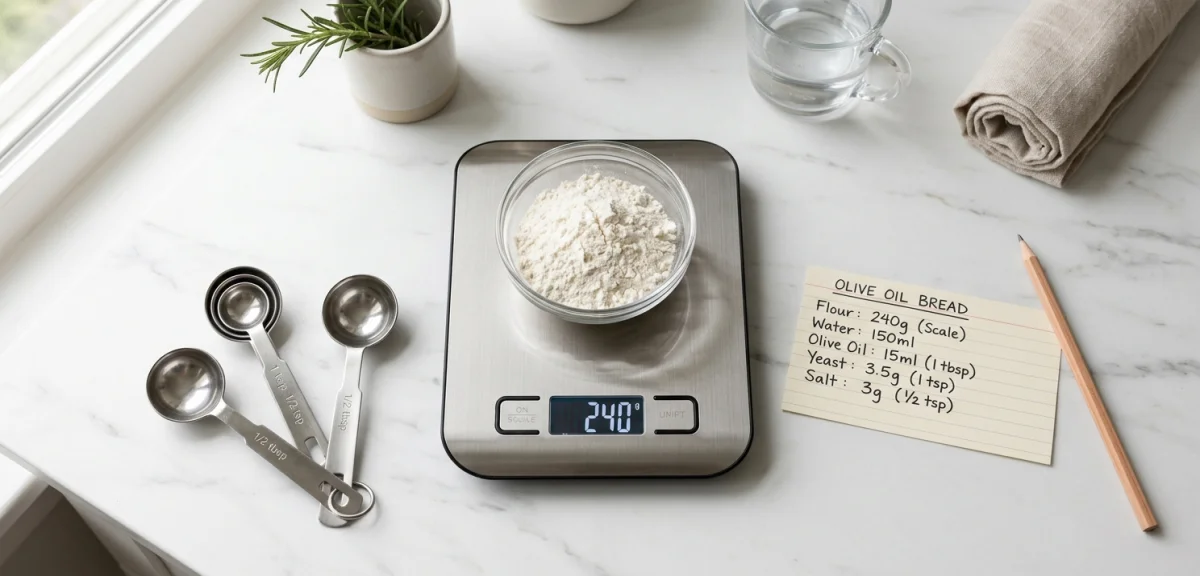
This matters because the formula breaks down when you're staring at "1¾ cups" and trying to multiply by 2.5 in your head. With gram weights, 420 g × 2.5 = 1,050 g. No ambiguity, nothing to convert, and you can read it directly off your kitchen scale.
The app also keeps the original recipe unchanged, so you can go back to the base version whenever you want.
Sources: USDA FoodData Central — large egg weight data; fdc.nal.usda.gov
 Lupita